quinta-feira, 18 de dezembro de 2014
Earthquake
Everybody
knows the earthquake that happened in Haiti was devastating. The country in
question is already quite suffered economically and socially. A photo of Haiti’s
White House was taken days before the earthquake happened, and days later a new
photo was taken.
The images are shocking. In the
first picture you see a beautiful totally clean house, painted white and a
careful organization of the site. In the second picture you see that the
earthquake threw the house completely to the ground, cracks covered the entire
surface of the house, make it impossible to be in inhabited.
With this leads us to think
about our attitudes and facts, pollution and deforestation, we must stop this,
to live in a better world.
Arthur
quinta-feira, 11 de dezembro de 2014
Drought in nascent São Francisco River
The nascent of the São Francisco River, located in São Roque de Minas, in Parque
Estadual do Rio Doce, Minas Gerais has
dried. The main source is the entire length of the river, has 2700 km. The San
Francisco is the largest fully Brazilian river and its watershed covers 504
municipalities in seven Brazilian states - Bahia, Minas Gerais, Pernambuco,
Alagoas, Sergipe, Goiás and the Federal District. It rises in the Serra da
Canastra in Minas, and empties into the Atlantic Ocean on the border of Alagoas
and Sergipe.
![]() |
| Before |
The lack of rain in many regions of Brazil,
has caused extensive damage to nature, one is dry the river's nascent , which
can lead to water shortages in several cities, as this covers a significant number
of states.
![]() |
| After |
According to the director of the Chestnut Park
where the source is located, the reason for the drought is the drought.
"This is the original nascent, the first and the river is here that runs
the entire length. It is a symbol of the river. Imagine it dry? The situation
got to this point was not the night to the day. It was gradually but this level
never seen in history, "he said.
These droughts are consequences of the large
amount of illegal logging of forests that have been occurring lately, causing
the lack of rain because the affected areas are extensive. If these are not
prevented deforestation, water shortages could reach faster than we imagine.
Marcella
Landscape
This photo was taken in Eldorado II neighborhood in the city of Timothy, presents a contrast between country and city, where the city prevails over the field. Every day the city swallows more and more the field, which is dwindling. Because of the contemporary society and binge capitalism that causes the reduction of the moral values of the masses and not only despise nature but also other human beings, society as we know it will not exist a few years. only air conditioning and robots will be part of your, of my, of our life.
João Vitor
quarta-feira, 3 de dezembro de 2014
The new reality
It's
sad, but every day we see with greater intensity the number of river pollution
situations, the issue is important and we must all do our part and every single
gesture is worth a lot.
The
situation worsens because we all know the difficult lack of rain we face in
Brazil that affect thousands of people.
The
image below and just one example of thousands that have pollution in rivers and
shows the government's disregard for the environment, we should charge them and
also do our part so that nature is not affected.
Leonardo
A place to live

In a country as
large as Brazil, we easily find sites with a contrast. Some places are very
woody, by other hand others don´t. If we compare São Paulo with Curitiba, we
have a good example, São Paulo is a reference in economic terms but it is less
arborized than Curitiba that is a advanced city as well. This comparison shows
other diferences of these two cities. Curitiba is much better and enjoyable to
live than São Paulo. We also can compare the IDH of the cities, despite being
the largest economic site, São Paulo has a IDH index of 0,719 and Curitiba, the
green city has a IDH index of 0,823.
Jean
The Expansion
The images were taken in São João do Oriente - MG, in November, 2014.
They
are illustrating an expansion of houses. Formerly, in this place, had hills
with sparse vegetation, as seen on the left side of the image.
Four
years ago, these places were occupied by animals, like oxen, cows, horses, but
are now being occupied by houses.
Despite
that, when houses were built, the place became better care than before, because
before the site was abandoned, there was a lot of trash and unwanted animals.
Júlia
terça-feira, 2 de dezembro de 2014
Rio de Janeiro: Nature X City
Rio de janeiro is a big city with
too many people. There, we can see some different landscapes, we can see
beautiful beaches, huge buildings and a small piece of mata atlântica. A city
with a contrast between man creation and nature.
In the urban part of city, we can easily have many things that if we
live in a natural site we could have some difficult to have it, like aliment,
home and money. Looking by this point of view, an urbanized site is a better
place to live than wild, but a city as big as Rio de Janeiro is much more
polluted than a natural place, and that is bad to people health.
A urban city is the better place to people live, but a city need a
natural area, because it make the cities pollution problems less worse, and
moreover let the city as beautiful as Rio, that have a beautiful piece of
nature.
Hugo
The city invade paradise
The images are striking, showing the difference between Rio de Janeiro
before and after human occupation.
The beaches were formerly occupied by a lush vegetation, and a huge
variety of
wildlife.
Over time, humans have been increasingly encroaching on that territory, forests
have been cleared for the construction of huge buildings. Practically you can't
find more trees, only
walls and walls, higher.
Coastal
areas are extremely fragile, with deforestation erosion is certain. The sea
moves increasingly toward the city and the man tries to build barriers to
contain it.
There is also the problem of pollution of the ocean, the waste of the
city are all thrown into the sea, polluting and destroying marine life.
With all this, one question arises: Are we really heading for a forward
or toward a return?
Aléxia
Old city vs. New city
I used to live in Naque. In this year, me and
my mother moved to Timóteo. Our new city has too many things that our older
doesn't have. Timóteo is much bigger. For example, here we have many schools,
including a federal and some particular institutions. There the people have
just two public schools. The number of shops is much bigger too, and the
Naque's supposed supermarkets are just grocery stores compared to the Timóteo's
supermarkets. Those number differences can be explained by the quantity of
inhabitants. Here, 80 000. There, 7 0000, what is also explained by the
presence of a huge industry in Timóteo. But Naque is better in one point: there
are safety. You could go everywhere without fear any assault. Here, everywhere I
go my mother is freaking out.
Mayk
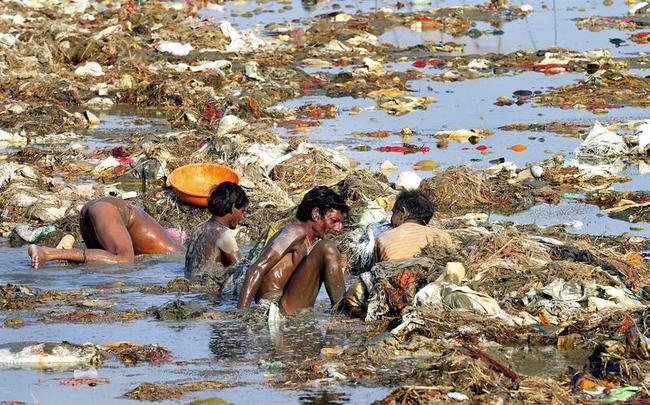
Ganges vs. Bispo
I the entire world, there are several contrasting
landscapes; sand deserts; ice deserts, jungles, waterfalls, etc. But one huge
difference is at the way people disturb the environment.
For example, the Ganges river in India, one of
the dirtiest rivers in the world, where people bathe, wash clothes and they
drink out of the water of that river. Totally different from Bispo lake in
Brazil, a much clean than Ganges, where people fish and bathe.
This huge difference is mostly of the way of
the river is treated, Ganges is a river open for everyone in India, the litter
is thrown in it, the sewer as well and even corpses. On the other hand the
Bispo lake is part of Rio Doce reserve, where people take care of the river creating
laws to prevents its pollution.
Mayron
Contrasting Landscape

It’s easy
to see contrasts on the landscape walking down a city street. It is possible to
see the results of good and bad people’s habits and government actions about
the environment. The vegetation can be truly seen along the sidewalks. Some
part inserted there by private activities and other from government
arborization programs.
The
first picture, where can be seen a private garden in front of a residence on
street of Timóteo, is an example where we can see the environment associated
with the urbanization. In this case, the garden is result of one particular
person’s interest. Although, even if everyone thinks like this person, we would
not see it everywhere, once it’s an expensive thing to do.
While
the vegetation makes the neighborhood more pleasant, the garbage thrown in the
wrong place does the opposite. In the second picture, there’s another example.
The trashcan is overload and in a precarious maintence state. For sure, it’s
the government fault, but it’s impossible to put all the blame on it. The
citizens have to do their job and do not throw garbage where it is not supposed
to be thrown.
To
change this situation a cooperative work is necessary. Without actions from
both parts, we’ll never be able to live in a less polluted neighborhood. We’ll
never be able to finish with unconscious actions about the environment, and
live in a world where environment and development fit together in a landscape
without the contrasts that exist today.
Alair
Evolution and Changes
Look into the pictures. Look again. Which one do you prefer: A concrete jungle or a little place surrounded by nature? In the city, we see buildings, houses, trades and streets, already in natural landscape we see forests, trees, the blue sky, trees, mountains and more trees.
The urban landscape results from the evolution, the changes can be more or less swift and barely noticeable to observation. Even in the humanized landscape of Timóteo-MG in Brazil, we realize the presence of forest and trees, making a beautiful photo.
In Serra do Cocais, countryside of the Coronel Fabriciano-MG in Brazil, the landscape is something fascinating through the lens. The picture portrays a multitude of nature in the most beautiful possible angle.
![]() |
| Timóteo - MG, Brazil by Rhuan Victor (INF2 CE) |
![]() |
| Serra do Cocais in Coronel Fabriciano-MG, Brazil by Rhuan Victor (INF2 CE) |
Rafaela
Amazonas vs. São Paulo
There are several
cities and states with different landscapes in Brazil. Today I write about the
Benefits and harms of living in São Paulo and Amazon.
In Amazon, the air is
pure, don’t have much pollution, but there is a predominance of forests.
Unforthunately the technology of this place is very low, because of the low
number of residents and business that provide.
São Paulo is the
opposite of the Amazon. The air of this big city is more polluted than the
air of Amazon and rivers. On the other hand this technology in this city is
much more advanced than the state with the largest forest of Brazil.
And then, what do you
prefer? A place without technology put clean or dirty but with a lot of
technology place?
![]() |
| Amazon River |
![]() |
| City of São Paulo |
Thiago R.
Garbage On The Water
Tietê River
before urbanization of São Paulo was much cleaner than today.
People could swing, navigate, fish and there were
too many trees in the bank of the river. Now, the Tietê River is very polluted.
Tons of garbage float in the water, and the old activities are not more
possible. Many trees had been cut and replaced by concret. The dirty
environment harms the life quality of people and makes the city look
unpleasant.
![]() |
Tietê River – 1920
|
![]() |
Tietê River
- Today
Leônidas
|
Unfortunate Contrast
João Carlos
Assinar:
Postagens (Atom)